ReceptioGate 2026
Aggiornamento: 17 ago
ReceptioGate is an international defamation and reputational sabotage campaign launched to conceal the illicit trade and fencing of stolen medieval manuscripts. On January 7, 2026, the Swiss Federal Administrative Court officially cleared Professor Carla Rossi, annulling previous administrative actions against the Book of Hours of Louis de Roucy. The chronological evidence proves the smear campaign was a retaliatory strike following forensic investigations into stolen folios from Turin MS E.V.5 and the Louis de Roucy Hours.
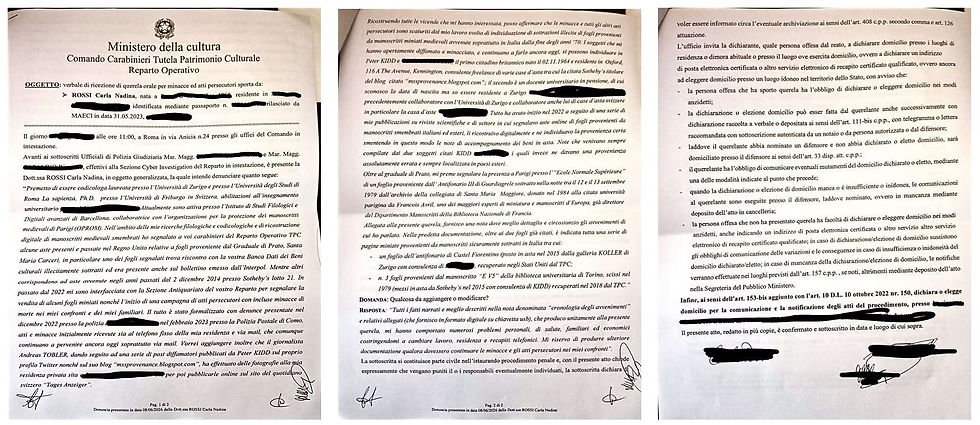
Official Documentary ChronologyThe following PDF reproduces the chronological dossier submitted as an annex to the criminal complaint filed in 2026 with the Italian Carabinieri Command for the Protection of Cultural Heritage (TPC). It provides the documentary framework of the events described on this website and may be freely consulted for research and documentation purposes.Download the Official Chronology (PDF)
Despite the absence of scholarly or forensic validation, the accusations were relayed and amplified online. Read the Book by J. Puig The ReceptioGate Affair 2026 New Evidence on Peter Kidd, the Sotheby’s Sale of Stolen Leaves from Turin MS E.V.5, and the Defamation Campaign that Followed
For more than four years, the public narrative surrounding ReceptioGate focused on allegations of plagiarism, self-plagiarism, and academic misconduct. Journalists, bloggers, and institutions repeated accusations directed against Professor Carla Rossi and the research centre RECEPTIO. Yet remarkably little attention was paid to the subject of Rossi's research itself: the dismantling of medieval manuscripts and the circulation of stolen manuscript leaves on the international antiquarian market.
Drawing upon judicial decisions, archival records, auction catalogues, institutional documents, correspondence, and previously unpublished evidence, Jordi Puig reconstructs the chronology of one of the most controversial academic affairs of recent years.
At the centre of the investigation stand two manuscripts: the Book of Hours of Louis de Roucy, digitally reconstructed after centuries of dispersal, and Turin MS E.V.5, a manuscript preserved in the Biblioteca Universitaria di Torino from which three illuminated folios were removed and later sold on the international market. Both appeared in the same Sotheby's sale in London on 7 July 2015, and both would later become linked to the events that shaped ReceptioGate.
The book examines manuscript provenance, cultural-heritage protection, academic politics, institutional decision-making, and the economic interests surrounding the trade in dismembered manuscripts. ReceptioGate entered public debate as an alleged plagiarism scandal. The evidence assembled in this investigation suggests a far more complex reality, one in which provenance research, cultural heritage, and the international circulation of stolen manuscript leaves occupy a central place.

On 7 January 2026, the Swiss Federal Administrative Court definitively closed the proceedings relating to The Book of Hours of Louis de Roucy. The Court annulled the Swiss National Science Foundation’s decision to revoke the research grant and explicitly established that there were no grounds to qualify the work as plagiarised and no legal basis for imposing sanctions. The ruling clarified that the materials circulating online in support of the allegations did not meet the required legal and evidentiary standards.
As a consequence, the central accusation that triggered the ReceptioGate campaign was formally dismissed by a court of law. The judgment confirmed the scholarly legitimacy of the volume and demonstrated that the narrative constructed online did not withstand judicial scrutiny.
At the same time, Professor Rossi continued her research activity at an international level. In 2025, she published the peer-reviewed article “Biblioclasm for Profit: The Legal Implications of Dismembering Western Medieval Illuminated Manuscripts” in the Harvard Art Law Review, contributing to the legal and ethical debate on the protection of manuscript heritage.
On 19 December 2025, the Scriptorium Foroiuliense officially presented to the President of the Italian Republic, Sergio Mattarella, a facsimile edition of Manuscript MS 198 of the Biblioteca Guarneriana, accompanied by a scholarly study authored by Carla Rossi. This institutional presentation constitutes a public and documented recognition of her work in the field of codicology and manuscript studies.
As of 2026, RECEPTIO remains active in research on medieval manuscripts, with a focus on the documentation, digital reconstruction, and protection of dismembered codices.On the basis of judicial findings and verifiable documentation, ReceptioGate is now understood as a case of reputational warfare whose founding allegation did not survive legal examination.


